NIS2 Compliance for SMEs: A 10-Step Implementation Roadmap
Learn how to make your SME NIS2-compliant in 10 steps. Protect your business and minimize the personal liability of the management.
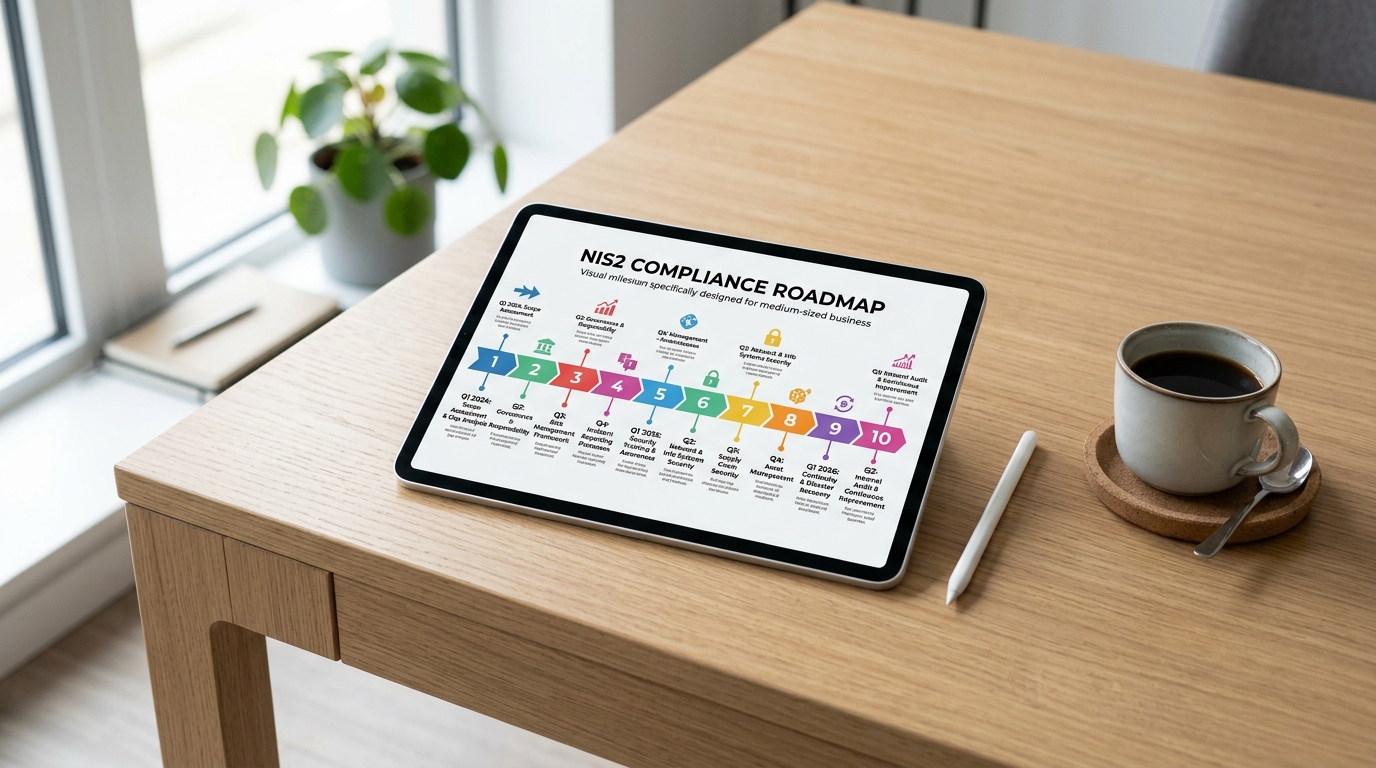
The NIS2 Era in the Mittelstand: Why You Need to Act Now
The new NIS2 implementation act officially came into force on 6 December 2025 and fundamentally reformed the Act on the Federal Office for Information Security (BSIG). For the German Mittelstand, this marks the beginning of a new era. Affected SMEs with fewer than 500 employees are now legally obliged to implement strict cybersecurity measures and to actively demonstrate them. If you have so far assumed that your company is too small to be on the radar of the regulatory authorities, you should urgently check your NIS2 obligation. The legal requirements reach far beyond classic IT protection.
Responsibility for cybersecurity now lies directly on your desk. In the event of breaches of duty in the area of IT security, the management is personally liable without limitation with their private assets. Delegating responsibility to external service providers or internal IT managers does not release you from the legal obligations relating to personal liability. Anyone who delays implementation risks not only substantial fines in the millions but also puts the survival of the entire business at stake.
- Personal liability of the leadership level: As a managing director, you bear the direct financial risk in the event of an inadequate risk analysis and insufficient precautions.
- Hard deadlines and reporting obligations: Companies must report security incidents within tight deadlines and demonstrate a certified risk management system.
- Pressure from the supply chain: Larger customers increasingly require their suppliers to prove NIS2 conformity, which makes the topic a competitive factor even for those indirectly affected.
To master this regulatory pressure, a structured roadmap is essential. Instead of laboriously coordinating various individual solutions for IT security, monitoring, and compliance, CAVRIX offers an integrated solution. With an automated connection of Managed IT, cybersecurity, and compliance, the legal requirements can be implemented without friction losses and without building up a huge in-house team of experts.
Steps 1 to 3: Inventory, BSI Registration, and Risk Analysis
The path to full conformity does not begin with complex software but with a structured assessment of your starting position. As a managing director or IT manager in the Mittelstand, you must gain clarity about your legal obligations early on. Before you establish technical protective measures, you should check your NIS2 obligation and secure the organizational foundations. The first three steps of your roadmap form the foundation on which all subsequent security measures build.
- Step 1: Applicability analysis for your business. Based on your number of employees, your annual revenue, and your industry, determine whether your company falls under the NIS2 regulation as an important or particularly important entity.
- Step 2: Official registration in the BSI portal. The BSI's new registration and reporting portal went live on 6 January 2026. Affected companies must register there without delay in order to avoid fines.
- Step 3: Methodical risk analysis of all IT assets. Systematically analyze your entire IT infrastructure for vulnerabilities. Record all hardware and software assets in order to proactively identify potential entry points for cyberattacks.
A complete risk analysis is the most important prerequisite for all further cybersecurity decisions. It shows you exactly where your crown jewels are at risk and where immediate action is needed. With our integrated service Compliance, we support you in carrying out this inventory and the risk analysis in a structured way. CAVRIX bundles the recording of risks and adherence to legal guidelines in a single platform, so that you reduce the effort for your business to a minimum.
Steps 4 and 5: Establishing Security Concepts and Incident Response Processes
The legal requirements under § 30 BSIG oblige your company to implement concrete risk management measures. A central building block is the formulation of written security concepts and policies that are actually lived out in everyday work. Without these clear guardrails, you as a managing director risk substantial sanctions as well as personal liability in the event of serious omissions. At the same time, the legislator requires a structured approach to detecting and handling incidents (incident response). Reacting in an improvised way in an emergency is no longer sufficient. You must plan ahead for how your team acts in an emergency in order to minimize damage and keep the business running.
From Concept to Practiced Crisis Response Capability
To anchor the requirements pragmatically in your business, you should organize the build-up of your IT security in three consecutive phases. This is about combining theoretical documents with a practical ability to act. With the CAVRIX Compliance module, you can manage the necessary evidence and policies in a structured way, while our comprehensive Cybersecurity solution ensures the technical detection of incidents around the clock.
- Formulate robust internal policies: Define understandable requirements for your employees. This includes password policies, the secure use of storage media, and clear access rights. Securing identities via MFA forms the basis for your security concept.
- Build an incident response plan: Create a concrete document that governs responsibilities and communication channels in the event of an attack. Who informs whom? Who is allowed to isolate systems? Who handles the legally required report to the Federal Office for Information Security (BSI) within the strict 24-hour deadline?
- Conduct regular tabletop exercises: An emergency plan is only as good as it works in an emergency. At least once a year, simulate typical attack scenarios such as ransomware infections in a dry run (tabletop exercise) with your IT team and management, in order to uncover weaknesses in the processes early.
Through this structured preparation, you reduce the risk of costly business interruptions to a minimum. Should an attacker nevertheless break through your barriers, a well-practiced process ensures that you remain able to act and fulfill the regulatory obligations without delay.
Steps 6 and 7: Business Continuity and Secure Backup Recovery
In the worst case, a successful cyberattack blocks your entire operation. To ensure the survival of your company, the NIS2 directive requires a structured risk management system in which managing directors in particular are held responsible. Core components of this are solid emergency plans and reliable recovery. With a well-thought-out business continuity management, you ensure that critical business processes can be continued as quickly as possible even in the event of serious incidents such as ransomware attacks. The Federal Office for Information Security (BSI) emphasizes that a step-by-step emergency management system massively increases resilience, especially for SMEs with limited resources.
Three Pillars for Your Resilience
- Establish crisis management: Define clear roles, responsibilities, and communication channels for an emergency in order to remain able to act in a moment of crisis.
- Encrypted backup strategy: Secure your data according to the 3-2-1 rule (three copies, two types of media, one of them stored externally and immutably offline).
- Regular disaster recovery tests: Repeatedly carry out tests of system recovery during ongoing operations to ensure that your backups actually work in an emergency.
At CAVRIX, we bundle these critical tasks directly into your IT operations. Our modules for Cybersecurity and Managed IT not only handle the continuous, encrypted backup of your data in the background. We also test the actual recoverability of your systems and document this in an audit-proof manner. Via the Command Center, you have the current status of your emergency readiness and all compliance evidence in view at all times and can react immediately in an emergency.
Steps 8 and 9: Enforcing Supply Chain Security and Access Controls
Cybercriminals often choose the path of least resistance. Instead of attacking your systems directly, they penetrate your networks via vulnerabilities at your external service providers. The NIS2 directive therefore obliges you to secure your own supply chain completely. You must systematically assess the security standards of your IT service providers and suppliers and require them contractually. With a well-thought-out strategy for supply chain security, you protect your company from these indirect threats and at the same time fulfill a central legal requirement.
In parallel, strict identity and rights management forms the foundation of your internal protection. The Federal Office for Information Security (BSI) urgently recommends the widespread use of multi-factor authentication (MFA) for all business-critical systems and administrative accounts. In addition, the principle of minimal rights allocation (least privilege) ensures that employees and external partners can only access the data and resources they absolutely need for their daily work.
- Risk assessment of third-party providers: Check the IT security evidence of all external service providers that have access to your systems.
- Introduction of strong authentication: Implement a consistent MFA requirement for every login from outside, especially for VPNs and cloud services.
- Rights allocation as needed: Revoke permanent administrator rights and grant permissions only for a specific purpose and for a limited time.
For managing directors in the Mittelstand, this implementation often means a considerable administrative burden. This is where the CAVRIX platform offers an integrated solution: with the Cybersecurity and Compliance modules, you control the security controls centrally via the Command Center. Instead of laboriously maintaining permissions manually or requesting security evidence individually, CAVRIX bundles the entire IT operation and cyber defense. This way, you protect your supply chain efficiently and ensure complete, NIS2-compliant documentation without burdening your team with additional bureaucratic effort.
Step 10: Training Your Employees and Continuous Monitoring
Fulfilling the legal NIS2 requirements is not a one-time project but a continuous cycle that must be deeply anchored in everyday work. Only when your workforce is actively sensitized and your IT systems are proactively monitored does cybersecurity become permanently effective in your mid-sized business. According to § 38 (3) BSIG, regular training of the management is even legally required. In order to effectively minimize the risk of personal liability of the management, you must demonstrably acquire sufficient knowledge to identify and assess cyber risks. At the same time, the law under § 30 BSIG obliges you to take regular measures for cyber hygiene and corresponding training for all employees.
The Three Pillars for Lasting NIS2 Compliance
- Regular employee training: Your employees are often the primary target of targeted social engineering attacks. Mandatory, practical training sustainably sharpens awareness of phishing, secure passwords, and basic cyber hygiene in everyday work.
- Proactive 24/7 system monitoring: To detect and ward off threats early, continuous monitoring of your entire infrastructure is essential. Our Cybersecurity service offers you professional and complete threat detection around the clock for this purpose.
- Automated evidence in the Command Center: In an emergency, you must be able to prove to the responsible supervisory authorities without gaps that all security precautions and training were carried out properly. Via the CAVRIX Command Center, you have your current security and compliance status in view in real time at all times.
With the innovative platform from CAVRIX, you no longer lose valuable time managing isolated point solutions. We combine daily IT operations via Managed IT with state-of-the-art protection through Cybersecurity and integrated Compliance modules. Should you have questions about your current audit status or wish for personal advice, you can arrange a free appointment via our contact page or contact us directly at info@cavrix.de. This way, you protect your business effectively, avoid liability risks, and keep your head free for your core business.
Minimizing Liability: How to Combine Compliance and IT Operations Wisely
The legal requirements of the NIS2 directive drastically tighten the obligations for the German Mittelstand. Under Paragraph 38 BSIG, the management bears the direct, non-delegable responsibility for personally approving the prescribed risk management measures and continuously monitoring their implementation in the business. In the event of culpable breaches of duty, those responsible face personal liability with their private assets. Anyone in your company who relies on a fragmented web of various individual solutions for IT support, IT security, and GRC software quickly loses track in an emergency. This not only increases operational costs but also creates dangerous compliance gaps.
- Seamless cooperation: No interface losses or unclear responsibilities between your everyday IT administration and specialized cyber defense.
- Continuous evidence: All compliance-relevant data is automatically recorded in the background, instead of having to laboriously gather it from various silos during an audit.
- Reduced administrative effort: A single integrated system saves valuable working time and avoids error-prone manual processes.
With the seamlessly coordinated services from CAVRIX, you intelligently combine these three pillars. The integrated modules Managed IT, Cybersecurity, and Compliance mesh directly with one another. Via the intuitive Command Center, you manage the entire status of your IT infrastructure and receive automated audit reports conveniently by dashboard or chat interface. This way, you effectively protect your business from cyber threats, fulfill all regulatory requirements without your own compliance team, and reliably minimize your personal liability as a managing director.
Frequently Asked Questions
When does the German NIS2 implementation act take effect?
The German act implementing the NIS2 directive (NIS2UmsuCG) officially came into force on 6 December 2025. Affected companies in the Mittelstand have had to implement the legal minimum measures since then without any transition period, in order to avoid regulatory fines and liability risks for the management.
How high are the fines for violations of NIS2?
The BSIG provides for drastic sanctions in the event of violations. For particularly important entities, fines of up to 10 million euros or 2 percent of global annual revenue can be imposed. Important entities risk fines of up to 7 million euros or 1.4 percent of annual revenue.
Who is personally liable for compliance with the cybersecurity measures?
Under Paragraph 38 BSIG, the management bears personal responsibility. Managing directors must approve the risk management measures and actively monitor their implementation. In the event of a culpable breach of duty, they are personally liable to their own company with their private assets.
What are the 10 minimum measures for SMEs under Paragraph 30 BSIG?
These include, among others: risk analysis and security concepts, handling of incidents (incident response), business continuity and backups, supply chain security, encryption, access controls such as multi-factor authentication (MFA), as well as regular cybersecurity training for employees.
How does registration with the BSI work?
The BSI's official registration portal went live on 6 January 2026. All affected businesses must register there and provide contact details, so that they can receive quick warnings and support from the authorities in an emergency.
Does an ISO 27001 certification help me with NIS2 compliance?
Yes, an existing certification in accordance with ISO 27001 is an excellent basis. The ten measure areas of the law essentially correspond to an information security management system (ISMS). With a certification, you already cover roughly 70 to 80 percent of the legal requirements.