Geopolitical risks for SMEs: monitoring supply chains
How you monitor geopolitical risks to your supply chain without a corporate budget and strengthen the resilience of your SME with open source tools.
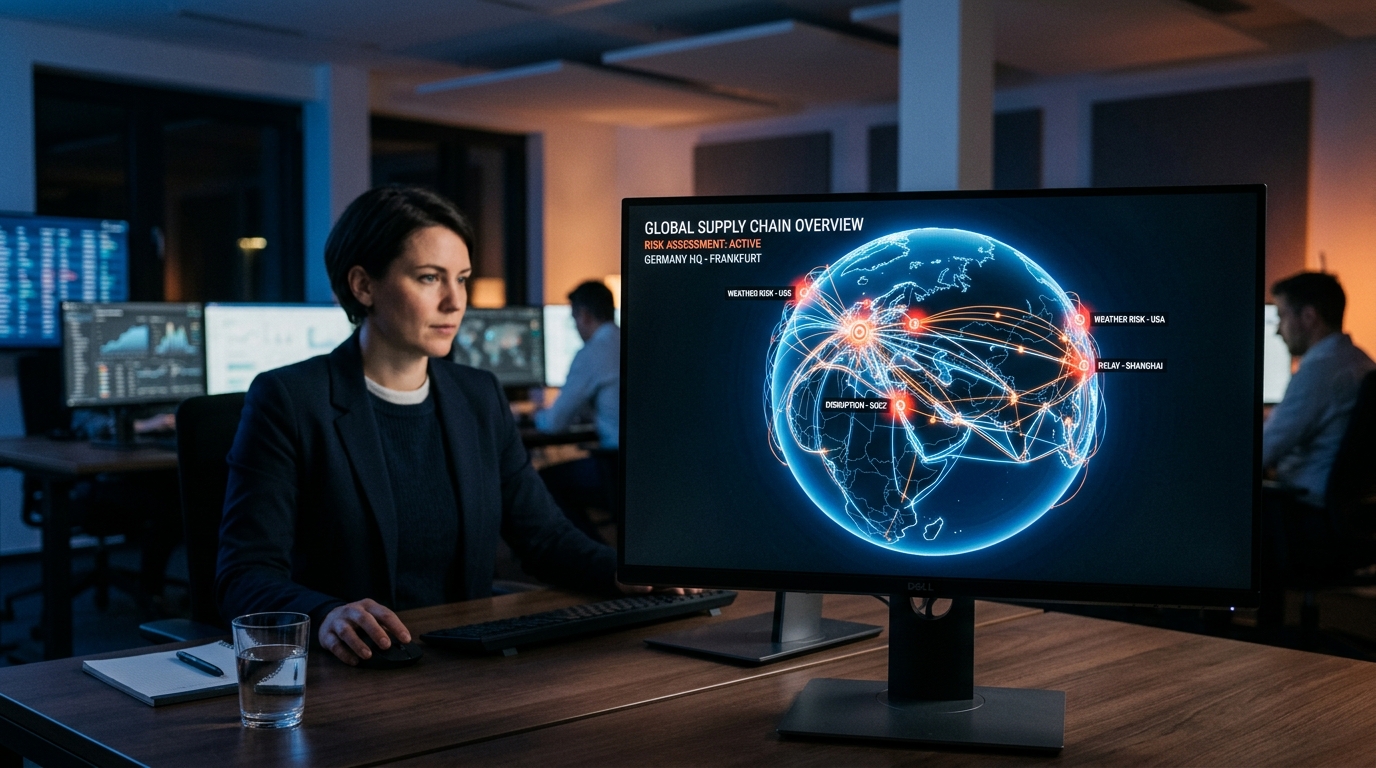
Geopolitical risks: why mid-sized companies have to act now
Geopolitical tensions have long ceased to be a problem that only affects multinational corporations. For the German Mittelstand too, unstable supply chains, blocked trade routes and cyber attacks by state actors are now among the biggest risks in day-to-day operations. As a managing director or IT lead you feel these dynamics directly in everyday work. Whether scarce raw materials, rising energy prices or unexpected delivery failures: a lack of geopolitical risk preparedness massively endangers the business resilience of your company and in the worst case can threaten its existence.
How urgent the need for action is can be seen in the Allianz Risk Barometer 2026: for Germany (400 respondents), cyber incidents rank first with 52 percent, followed by business interruption with 40 percent and changes in legislation with 28 percent. To secure supply chains proactively and avoid expensive production outages, SMEs have to professionalise their risk analyses fundamentally. This concerns not only the physical purchase of goods but equally the digital infrastructure, since supply chain security is expressly anchored as a risk management measure for essential and important entities in Section 30 paragraph 2 number 4 BSIG in Germany. The following remarks are a professional assessment and not legal advice.
These geopolitical crises affect your business through different channels. For mid-sized companies, the following three areas of danger are of strategic importance above all:
- Failures and delays at suppliers: import restrictions, political sanctions or physical blockades of important transport routes disrupt the flow of materials significantly.
- Targeted cyber risks for the IT infrastructure: politically motivated actors increasingly attack German SMEs in order to put pressure on the economy via weaknesses in your systems.
- Compliance requirements: Section 30 paragraph 2 number 4 BSIG in Germany requires essential and important entities to take measures for the security of the supply chain. There is, by contrast, no legal obligation to maintain a geopolitical situational picture.
To counter these multi-layered threats effectively, however, your company does not need a multi-million team of analysts or external consultants. With modern, digitalised approaches and lean monitoring tools you can capture geopolitical early warning signals cost-effectively and systematically. In this way the ability of your business to act can be secured permanently even with limited resources.
The challenge: risk monitoring without a corporate budget
Geopolitical crises, regional conflicts and sudden trade barriers hit the German Mittelstand directly and unprepared today. Geopolitical risks are now among the most pressing dangers for mid-sized businesses. But while international corporations maintain their own departments for geopolitical analysis and license expensive proprietary threat intelligence platforms, smaller businesses face an immense hurdle. The high annual licence fees and the specialist staff needed to evaluate complex situational pictures generally blow any SME budget. Without a structured early warning system, however, you risk serious supply bottlenecks and unexpected business interruptions.
Why classic approaches fail
For SMEs with fewer than 500 employees, building an in-house crisis management unit is simply uneconomical. Trying to monitor global threats manually by reading quality media quickly leads to information overload without any real operational benefit. It usually fails on three central factors:
- Astronomical licence fees for closed analysis platforms
- Lack of internal specialists to evaluate complex data streams
- High complexity in translating global events into concrete risks for your suppliers
To escape this cost trap you need a lean and automated approach that precisely filters out the signals relevant to your business. Monitoring geopolitical dangers has long ceased to be an optional project; it is closely linked to your cybersecurity and to regulatory compliance requirements, especially in the context of the legally required supply chain security. The good news is that you do not have to hire expensive teams of analysts for this. Modern open source applications and smart automation allow your IT to aggregate global threat data independently. Below you will learn how to establish such an early warning system in your organisation without a corporate budget and which signals really matter for your supply chain and your operations.
The open source alternative: what is the World Monitor project?
Geopolitical crises, trade conflicts and sudden supply bottlenecks often hit the German Mittelstand unprepared. While large corporations employ their own teams of analysts, smaller companies usually lack the budget for expensive proprietary information services. This is where a powerful open source alternative comes in: the World Monitor project. Started on 8 January 2026 by Elie Habib on GitHub, this platform offers a free and sovereign technological basis for capturing global signals in a structured way and making them usable for your own risk analysis[1].
- Development and activity: the repository koala73/worldmonitor on GitHub is actively maintained. It is a situational picture and visualisation tool and expressly not a security product.
- Global community: around 67,900 stars and around 10,400 forks on GitHub, as of 22 July 2026. These figures prove reach, not quality or security.
- Sovereign operation: the system can be tested via the hosted instance at worldmonitor.app or operated as a fully independent instance of your own.
- Licence model: the software is available under AGPL-3.0-only. Commercial use and self-hosting are permitted, provided the copyleft and source disclosure obligations are respected. For proprietary integrations the author offers a separate commercial licence.
For you as a managing director or IT lead, this project offers the chance to build a strategic early warning system without having to take out expensive subscriptions. Independence from external analysis providers strengthens the resilience of your company considerably. Securing operations in this way is closely interwoven with regulatory obligations: while you detect geopolitical dangers, professional supply chain security under NIS2 helps you also to repel digital threats to your suppliers. Together with holistic cybersecurity you thus lay the foundation for crisis-proof operations.
The features in detail: global signals on your desk
To identify geopolitical risks early, your mid-sized company does not need armies of expensive analyst teams or unaffordable corporate budgets. The open source project World Monitor bundles global events directly on your desk[1]. By aggregating more than 500 curated news sources from 15 different categories, the system filters the global noise and delivers precise, thematically sorted signals. This structured density of information forms the reliable basis for identifying threats to your sites, partners or transport routes early and reacting strategically.
Visual situational pictures and risk assessment in real time
The technical implementation impresses with a highly developed and fluid visual interface that presents complex data streams in an understandable way. You can switch flexibly between an interactive 3D globe and a high-performance WebGL flat map, both equipped with a total of 56 specialised map layers[1]. These layers visualise everything from meteorological data through critical infrastructure changes to regional conflicts that could impair your daily operations. A central tool for your strategic planning is the Country Instability Index (CII). This index assesses geopolitical stability for 31 so-called tier 1 countries and enables you to plan routes and locations with foresight, before bottlenecks arise in the physical supply chain.
- Comprehensive information base: access to more than 500 curated news sources in 15 categories.
- Visual precision: switch between 3D globe and WebGL flat map with 56 detailed map layers.
- Strategic index: Country Instability Index (CII) for 31 countries for the exact risk assessment of your supply routes.
Geopolitical instability has a direct effect on the digital and physical security of your company. An outage at a critical partner can endanger your entire value chain, which is why gap-free supply chain security is also indispensable in regulatory terms. CAVRIX supports you in mastering these risks proactively and cost-effectively. While World Monitor delivers the global situational picture, CAVRIX secures your operational systems with tailored services such as managed IT and cybersecurity, so that your business stays stable even in stormy times.
Local AI and market data: financial radar and Ollama integration
Geopolitical risks do not only concern physical borders, they have a direct effect on global markets. The open source project World Monitor by Elie Habib offers an integrated financial radar for this, bundling data from 29 exchanges as well as information on commodities and cryptocurrencies[1]. For you as a managing director or IT lead in a mid-sized company, this means you can identify macroeconomic shifts and supply bottlenecks early. These market observations can be linked directly with your own strategy for supply chain security, without sensitive queries leaving your company.
- Real-time financial radar: direct connection to 29 international trading venues including global commodity markets and crypto exchanges.
- Local AI analysis: complete evaluation of your geopolitical scenarios via Ollama on your own hardware.
- Maximum confidentiality: no external server connections or API keys are needed for the artificial intelligence.
- Infrastructure security: native execution as a desktop application via the high-performance Tauri 2 framework.
The decisive advantage of this architecture lies in uncompromising data protection. While conventional tools transmit your queries and sensitive supply chain scenarios to external cloud providers, the local integration of Ollama processes all queries directly on your system. No API keys or paid third-party subscriptions are required. As a result, knowledge about your strategic weak points, critical suppliers and future alternative routes remains absolutely confidential in your hands. In combination with proactive services such as cybersecurity from CAVRIX you thus build a resilient, secure and legally compliant monitoring structure.
Legally secure implementation: licensing and self-hosting in SMEs
Introducing open source solutions such as World Monitor gives you excellent opportunities to monitor geopolitical risks without expensive software packages. Even so, when implementing them in a mid-sized business you have to observe the legal framework precisely. The GitHub repository koala73/worldmonitor by the author Elie Habib is licensed under AGPL-3.0-only[1]. This licence permits free self-hosting, commercial use and SaaS operation, but ties this to a strong copyleft. As soon as you modify the source code and offer the application over a network, under Section 13 of the AGPL you must offer the users of that service the corresponding source code.
| Scenario | Licence type | Legal condition |
|---|---|---|
| Classic self-hosting without code changes | AGPL-3.0-only | Commercial use and SaaS permitted; without modification, Section 13 AGPL triggers no additional disclosure obligation for your own code. |
| Modification of the source code for your own services | AGPL-3.0-only (strong copyleft) | Obligation to offer the users of the service the corresponding source code of the modified version under the same licence (Section 13 AGPL). |
| Proprietary use & closed source code | Commercial licence | A separate licence agreement directly with the author Elie Habib is required. |
For companies that want to use World Monitor without publishing their own adaptations, or for closed, proprietary systems, Elie Habib expressly offers a separate commercial licence. The same applies if you want to claim official trademark rights to the project. Since software compliance and IT governance are moving ever more into focus in the wake of regulatory requirements such as NIS2, legally secure licensing also protects you against legal risks that can extend to the liability of management. If your company lacks the internal capacity for continuous licence and risk monitoring, the experts at CAVRIX support you with seamless integration as part of our services for cybersecurity and compliance.
Sovereign IT infrastructure: how CAVRIX strengthens your risk preparedness
Reliable geo monitoring via open source solutions such as World Monitor[1] requires a highly available and comprehensively secured IT environment. If your monitoring infrastructure fails at the moment of a critical supply chain disruption, the strategic advantage evaporates. For the German Mittelstand, a resilient system base is therefore not an option but the basic prerequisite for any successful crisis preparedness. This is exactly where CAVRIX comes in and creates the technical foundation so that you can receive geopolitical signals without downtime.
With our cybersecurity service for mid-sized companies and proactive system maintenance through managed IT, the operation of your analysis tools is protected without gaps. In addition, the legislator requires comprehensive protection of your digital processes through regulatory requirements. The German implementation anchors the security of the supply chain in Section 30 paragraph 2 number 4 BSIG in Germany as one of the required risk management measures. No legal obligation to maintain a geopolitical situational picture follows from this. CAVRIX makes sure that your own systems remain resilient while you meet all statutory documentation and due diligence obligations.
- Holistic resilience: continuous monitoring and automatic patch management through managed IT protect your local and cloud-based monitoring systems.
- Secure compliance: integrated modules for compliance support you in producing audit-ready reports and minimise personal liability risks for management.
- Round-the-clock protection: continuous threat defence through cybersecurity reliably protects your sensitive logistics and analysis data.
Via our AI-native Command Center you keep an eye on the security status of your IT infrastructure and on active compliance tasks at all times, since these are integrated directly into your everyday communication tools such as Microsoft Teams or Slack. In this way your company establishes sovereign risk preparedness and IT security at corporate level, entirely without the budget or the administrative effort of your own large corporate department.
Frequently asked questions
How does geopolitical instability affect my German mid-sized business?
Geopolitical tensions affect supply chains directly through delivery delays and raw material shortages. In the Allianz Risk Barometer 2026 for Germany, cyber incidents rank first with 52 percent and business interruption second with 40 percent. For essential and important entities, Section 30 paragraph 2 number 4 BSIG in Germany also requires measures for the security of the supply chain.
What is World Monitor and who developed it?
World Monitor is an open source project on GitHub (koala73/worldmonitor) started on 8 January 2026 by Elie Habib. It visualises geopolitical situational pictures, has around 67,900 stars on GitHub (as of 22 July 2026) and offers a hosted instance at worldmonitor.app. It is not a security product and is not offered by CAVRIX as a product.
Which data sources does World Monitor use for risk analysis?
The tool draws on more than 65 external data providers and bundles more than 500 curated news sources in 15 categories. It also visualises risks on a 3D globe and a WebGL flat map with a total of 56 map layers.
Is using World Monitor completely free for my SME?
Yes, use, self-hosting and commercial deployment are permitted free of charge under AGPL-3.0-only. However, the copyleft principle applies: if you modify the code and offer the application over a network, you must offer the users of that service the corresponding source code. Only for proprietary use with closed source code or for official trademark rights does the author offer a separate licence.
How do I protect my data when analysing with local AI?
World Monitor enables local AI evaluation via the Ollama integration entirely without API keys or external servers. As a result, all analysed geopolitical data and internal reports remain completely within your own protected IT infrastructure.