DORA vs. NIS-2: What Mid-Market Financial Firms Need to Know Now
DORA vs. NIS-2: find out which regulation applies to your mid-market financial firm and how you cover both frameworks efficiently with CAVRIX.
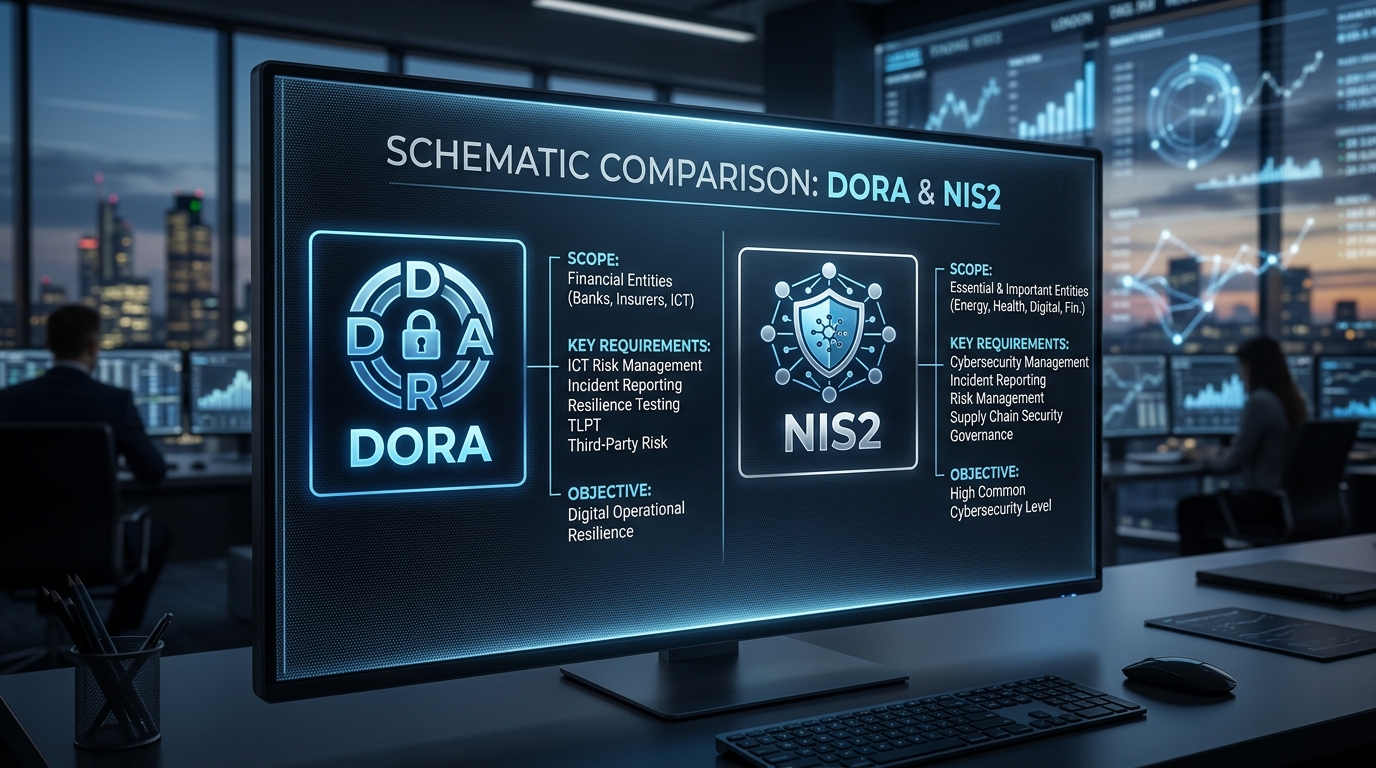
DORA and NIS-2: why the wave of regulation is reaching mid-market firms too
The days when regulatory requirements for IT security only concerned large corporations are firmly behind us. For mid-market financial firms in Germany, the European NIS-2 Directive and the DORA regulation (Digital Operational Resilience Act) have become a concrete reality. As a managing director or IT lead, you face the task of protecting your company from cyber risks while also meeting complex legal obligations. Both bodies of rules share a common goal: they aim to raise the digital resilience of the economy, and of the financial sector in particular, to a new level in order to prevent widespread outages.
In Germany, the NIS-2 Directive is being transposed into national law through the new NIS-2 Implementation Act. At the same time, the DORA regulation applies directly to the entire financial sector from 17 January 2025. There is an important relationship between the two frameworks: DORA acts as lex specialis, meaning it is the more specific law for financial firms. This means that DORA's detailed requirements for risk management and incident reporting take precedence over the more general NIS-2 provisions. Even so, the duty to secure your systems remains and calls for a systematic approach.
Personal liability and new obligations for the leadership level
A central aspect of the new legislation concerns the personal liability of senior management. You can no longer simply hand responsibility for IT security and compliance to external providers or internal specialists without keeping control yourself. As a managing director, you are personally obliged to approve the cybersecurity measures and to monitor their implementation. Failures can lead to significant fines for the company and, in the worst case, to direct liability affecting your personal assets. That turns transparent risk management into a matter for the boardroom.
| Criterion | NIS-2 Directive | DORA regulation |
|---|---|---|
| Main focus | General cybersecurity for critical and important sectors. | Digital operational resilience specifically for the financial sector and its partners. |
| Applicability | Depends on national transposition through German law. | Binding application in all EU member states from 17 January 2025. |
| Core requirements | Risk management, security measures and standardized reporting obligations. | ICT risk management, control of third-party risk and penetration testing. |
For mid-market companies, meeting these requirements with in-house resources is often an enormous challenge. CAVRIX offers pragmatic solutions here that are built specifically for the German mid-market. By combining professional support for compliance with proactive cybersecurity, you can achieve the required level of protection without a large in-house team of experts. Through the Command Center, you keep an eye on the security status of your IT systems and on compliance with all requirements, while services like Managed IT take the day-to-day operation of your infrastructure off your plate.
DORA as lex specialis: which rules apply to your business, and when?
When you analyze the regulatory landscape as a managing director or IT lead in the mid-market, you inevitably come across the principle of lex specialis. This legal principle states that a more specific law prevails over a more general one. It is set out specifically in Article 4 of the NIS-2 Directive. Because the European Digital Operational Resilience Act (DORA) was developed specifically for the financial sector, it counts as a sector-specific act of the Union. For you, this means that wherever DORA governs IT security and incident reporting for your company, these specific rules fully override the more general rules of the NIS-2 Directive. To be sure whether your business falls under the new requirements at all, a NIS-2 quick check helps you get an initial orientation.
Why DORA takes precedence for pure financial firms
As a directly applicable EU regulation, DORA does not first have to be transposed by a national law in Germany; it takes effect directly[1]. For pure financial firms, banks and insurers, it is the primary framework for digital operational stability. In its requirements for IT risk management, digital resilience testing and monitoring of third-party providers, DORA often goes a step further than the national NIS-2 Implementation Act[1]. The goal is to protect the entire financial market from systemic IT risks. If your company primarily provides financial services, you therefore focus on meeting the DORA criteria, while the classic NIS-2 obligation recedes into the background for you.
Responsibilities in the German market: BaFin and BSI
This split in the law also clearly assigns the regulatory responsibilities in Germany. For financial firms that fall under the DORA regulation, the Federal Financial Supervisory Authority (BaFin) is the central supervisory body. It monitors compliance with the security requirements and is the recipient of your reports on significant IT incidents. The Federal Office for Information Security (BSI), by contrast, remains the central authority for the general cybersecurity framework and coordinates the defense against national threats under NIS-2. As a mid-market managing director, you therefore need to know exactly which authority is responsible for you, in order to avoid fines or personal liability.
| Aspect | DORA | NIS2 |
|---|---|---|
| Main focus | Specific digital resilience and IT risk management in the financial sector | General level of cybersecurity across critical and important sectors |
| Responsible supervisor | BaFin (for financial firms in Germany) | BSI (for national cybersecurity) |
| Type of law | Directly applicable EU regulation | EU directive, transposed into German law (BSIG requirements) |
Whether your business ultimately falls primarily under DORA or under NIS-2, the required security measures overlap considerably in practice. With CAVRIX, you do not have to handle these complex requirements alone. The Managed IT, Cybersecurity and Compliance services give you a stable foundation that meets modern security standards and automates the regulatory evidence. Through the intuitive Command Center, you can keep track of the current status of all your company's measures and IT systems at any time.
The key differences and overlaps at a glance
If you work as a managing director or IT lead in the financial sector, you face a double wave of regulation. The Digital Operational Resilience Act (DORA) and the NIS-2 Directive pursue the same goal (strengthening cybersecurity), but they do so in different ways[1]. The most important principle you need to know is that of lex specialis: because DORA counts as the more specific law for the financial sector, it overrides the more general requirements of NIS-2 wherever they overlap[1]. Even so, NIS-2 often acts as a safety net for other parts of the business, which is why a solid comparison such as NIS-2 vs. ISO 27001 is essential for mid-market companies.
ICT risk management and the principle of lex specialis
While NIS-2 is a directive that was translated into German law through national statutes such as the BSIG, DORA is an EU regulation[1]. For you, this means that DORA applies directly and with no room for local deviations. For ICT risk management, DORA requires highly specific processes for identifying, assessing and remediating risks. For your mid-market financial firm, that means you have to document your existing security concepts seamlessly and continuously adapt them. With Compliance and Cybersecurity services from CAVRIX, you can cover these complex requirements for IT resilience and risk monitoring in an automated way, without your own huge compliance team.
Strict reporting deadlines and demanding testing obligations
The deadlines for reporting security incidents are strict under both frameworks, but they differ. If a serious ICT incident occurs, DORA requires an initial report within 4 hours of classification[2]. Under NIS-2, you have a little more time for the so-called early warning, namely 24 hours[1]. DORA also tightens the screws on testing obligations: you not only have to carry out regular vulnerability assessments, but, depending on your classification, also demonstrate demanding, threat-led penetration testing[3].
| Criterion | NIS-2 Directive | DORA regulation |
|---|---|---|
| Type of law | EU directive, transposed into national law (BSIG) | EU regulation, applies directly and immediately in all member states |
| Initial report for incidents | Within 24 hours of becoming aware of the incident | Within 4 hours of classifying the serious ICT incident |
| ICT third-party providers | Supply chain security must be considered in risk management | Obligation to keep a detailed register of information on all third-party providers |
| Regular testing obligations | Regular review and assessment of the effectiveness of security measures | Annual security and resilience tests, plus partly complex penetration tests |
Strict third-party risk management as a lever
In the mid-market in particular, financial firms rely on external partners, whether for cloud applications, core banking systems or IT infrastructure. Here, DORA requires seamless monitoring of your ICT third-party providers. You have to keep a so-called Register of Information and ensure contractually that your providers meet minimum cybersecurity standards[2]. With CAVRIX as your partner for Managed IT and Cybersecurity, you do not have to reinvent this wheel. We offer fully integrated protection around the clock and deliver the necessary documentation directly through our Command Center, so you can provide evidence of robust third-party management at any time without hassle.
Simplified risk management: relief for smaller financial firms
If you run a mid-market financial firm, you often feel swamped by huge bureaucratic waves when it comes to regulation. DORA is no exception here. But lawmakers recognized that a small financial firm cannot muster the same resources as a large international bank. Under the principle of proportionality, Article 16 of DORA offers a simplified ICT risk management framework that noticeably reduces the bureaucratic burden for eligible businesses.
Who benefits from the relief under Article 16?
Not every financial firm can automatically fall back on the simplified framework. The relief is intended for specific actors, including small and non-interconnected investment firms, smaller payment institutions and certain institutions for occupational retirement provision[4]. In Germany, this group is even extended by the Financial Market Digitalization Act (FinmadiG) to include certain institutions regulated under the KWG or VAG[4]. Whether your business falls under these simplified rules or has to act in full can be clarified in advance with a structured NIS-2 check.
| Area | Standard ICT framework | Simplified framework (Art. 16 DORA) |
|---|---|---|
| Documentation | Extensive, standalone strategies for digital operational resilience required. | No standalone resilience strategy; integration into a leaner internal control framework. |
| Security testing | Regular, advanced tests such as threat-led penetration testing (TLPT) mandatory. | No advanced TLPT tests needed; classic, pragmatic vulnerability assessments instead. |
| Third-party risk | Full management and detailed risk assessments of all external ICT providers. | Third-party assessment obligations drop entirely for micro-enterprises with fewer than 10 employees. |
Micro-enterprises benefit particularly strongly, that is, businesses with fewer than 10 employees and an annual turnover of no more than 2 million euros[4]. For them, the complex management of ICT third-party risk drops away entirely[4]. This not only saves valuable working time, it also protects you from crushing mountains of contracts and compliance documents that would be almost impossible to handle day to day.
How to master the simplified requirements day to day
Even though Article 16 of DORA brings noticeable relief, it is no free pass for IT security. You still have to establish basic protective measures, detect threats early and be able to report security incidents quickly[5]. For mid-market businesses, handling this on their own is often a major challenge because the necessary specialists are missing. This is where working with a managed security partner pays off. Through professional cybersecurity, you make sure your company is seamlessly protected, without having to build up your own expensive team of experts.
CAVRIX's holistic approach combines professional Managed IT with deep security expertise. We support you in implementing the required security measures without unnecessary ballast. Through our innovative Command Center, you can view and control the current security status of your network at any time. That way, you combine lean, compliant processes with reliable protection and can focus fully on your actual business again.
How CAVRIX unites cybersecurity and compliance for your business
Implementing DORA and NIS-2 at the same time places enormous hurdles in front of the German mid-market. Companies with fewer than 500 employees usually lack the personnel and financial resources to build complex ICT security concepts and continuous audits in-house. This is exactly where CAVRIX's pragmatic approach comes in. We offer a turnkey platform that harmonizes state-of-the-art security infrastructure with the regulatory requirements.
Automated compliance and continuous security monitoring
Our Cybersecurity service protects your business around the clock through a professional Security Operations Center (SOC) and proactive SIEM monitoring. Cyber threats are stopped with Endpoint Detection and Response (EDR) before they can cause damage. In parallel, the Compliance service ensures seamless adherence to the legal requirements. Instead of laboriously collecting evidence by hand, our software takes over the automated capture of all relevant data and produces audit-proof reports.
| Requirement (DORA / NIS-2) | Manual effort in the business | Solution through CAVRIX |
|---|---|---|
| 24/7 monitoring and detection | Building your own round-the-clock SOC team is barely viable economically. | Cybersecurity provides continuous 24/7 SOC and SIEM monitoring. |
| Evidence and reporting | Manual documentation for audits eats up hundreds of valuable working hours. | Compliance delivers automated audit reports and seamless evidence. |
| Interface and control | Fragmented tools and unclear responsibilities overload the internal IT team. | The Command Center bundles all security and compliance data in real time. |
Relieving the IT department through the Command Center
Both NIS-2 and DORA require mid-market players to have professional ICT risk management, fast incident reporting and regular review of their security measures[6]. So that you as a managing director or IT lead are not flying blind, the Command Center brings all the threads together in one central place. Through this intuitive interface, you can query your company's current security and compliance status at any time and receive clear notifications directly in your familiar communication channels. That way, you take the manual effort off your team and keep full control over your business's digital resilience, while effectively minimizing management liability at the same time.
Your roadmap to a resilient IT infrastructure with Managed IT
Financial firms in the German mid-market face a double regulatory challenge: on one hand, the national law implementing the NIS-2 Directive requires comprehensive security measures; on the other, the European DORA regulation sets even stricter standards for digital operational resilience in the financial sector[1]. For affected companies, the principle of lex specialis applies: because DORA is a more specialized set of rules for the financial sector, it takes precedence over the general requirements of NIS-2[1]. Even so, the basic obligations to secure your systems and the personal liability of management remain. For you as a managing director or IT lead, that means you have to build your IT infrastructure so that it holds up flexibly and in a legally sound way against both frameworks.
To implement these demanding requirements pragmatically in the mid-market, you do not need an expensive in-house compliance department. Combining Managed IT with the integrated services from CAVRIX offers an efficient solution. By outsourcing to a specialized managed security partner, you not only get a highly available IT infrastructure, you also benefit from built-in compliance. The Managed IT, Cybersecurity and Compliance services mesh seamlessly to close vulnerabilities automatically and ensure continuous adherence to all legal requirements. Through the Command Center, you keep full control and transparency over your company's current security status at all times.
The five steps to operational resilience and compliance
The path to a secure IT infrastructure calls for a structured approach that covers both technical and organizational protective measures. A robust roadmap helps you identify and fend off potential security risks early, while all legal requirements are met in the background at the same time. With the right tools and a reliable partner, this process can be carried out without interrupting ongoing operations. The following steps show you how to secure your IT infrastructure for the long term and meet the criteria of DORA and NIS-2.
- Complete inventory: a seamless record of all IT systems, software licenses and data flows forms the indispensable basis for risk management and audit reports.
- Proactive patch management: the automatic distribution of security updates as part of Managed IT closes known vulnerabilities before attackers can exploit them.
- Continuous security monitoring: integrating Cybersecurity solutions ensures permanent monitoring of your network and enables a fast response to incidents around the clock.
- Centralized compliance evidence: the automated collection of evidence makes it easier to produce audit reports and reduces administrative effort to a minimum.
- Regular awareness training: continuous training strengthens your team's security awareness, effectively reducing the risk of human error.
A decisive success factor for mid-market companies is straightforward access to relevant security data. This is where the Command Center comes in, serving as an AI-supported interface. It translates complex security events and compliance status reports into understandable information that you can access directly through familiar channels such as Microsoft Teams or Slack. Instead of working through cluttered dashboards, you simply ask by text for the current patch status or open tasks. That makes the continuous monitoring of your operations considerably easier day to day and gives you the assurance that your IT infrastructure meets the requirements of DORA and NIS-2 at all times.
Frequently asked questions
What is the difference between DORA and NIS-2?
The main difference lies in the scope and legal nature: NIS-2 is an EU directive for 18 critical sectors that each country has to transpose into national law. DORA is a directly applicable EU regulation aimed specifically at the digital resilience of the financial sector.
When do the requirements of DORA and NIS-2 apply in Germany?
DORA has been fully and directly applicable to financial firms since 17 January 2025. The national requirements of the NIS-2 Directive have applied in Germany since the implementation act came into force on 5 December 2025.
What relief is there for micro-enterprises under DORA?
Micro-enterprises with fewer than 10 employees and an annual turnover below 2 million euros benefit from a simplified ICT risk management framework under Article 16 of DORA. They have to present less complex test procedures and reports, but they are not entirely exempt from the obligations.
What does lex specialis mean in the context of DORA and NIS-2?
Lex specialis means that DORA, as the specific law for the financial sector, takes precedence over the general NIS-2 Directive. Pure financial firms therefore have to follow DORA first and foremost, wherever DORA conclusively governs the corresponding security and reporting obligations.
Who monitors compliance with DORA and NIS-2 in Germany?
For monitoring DORA in the financial sector, the Federal Financial Supervisory Authority (BaFin) is primarily responsible. Compliance with the NIS-2 requirements for other critical sectors is overseen by the Federal Office for Information Security (BSI).
How does a managed security partner help with compliance?
A qualified managed security partner like CAVRIX covers the technical and regulatory requirements with standardized services such as Cybersecurity and Compliance. That minimizes your internal effort through automated patch management, 24/7 monitoring and audit-proof IT documentation.