Digital Risk Protection: Brand, Data, Payments Targeted
Digital Risk Protection combines defense against fake shops, data leaks, and payment fraud. Learn how SMEs can detect complex cyberattacks earlier.
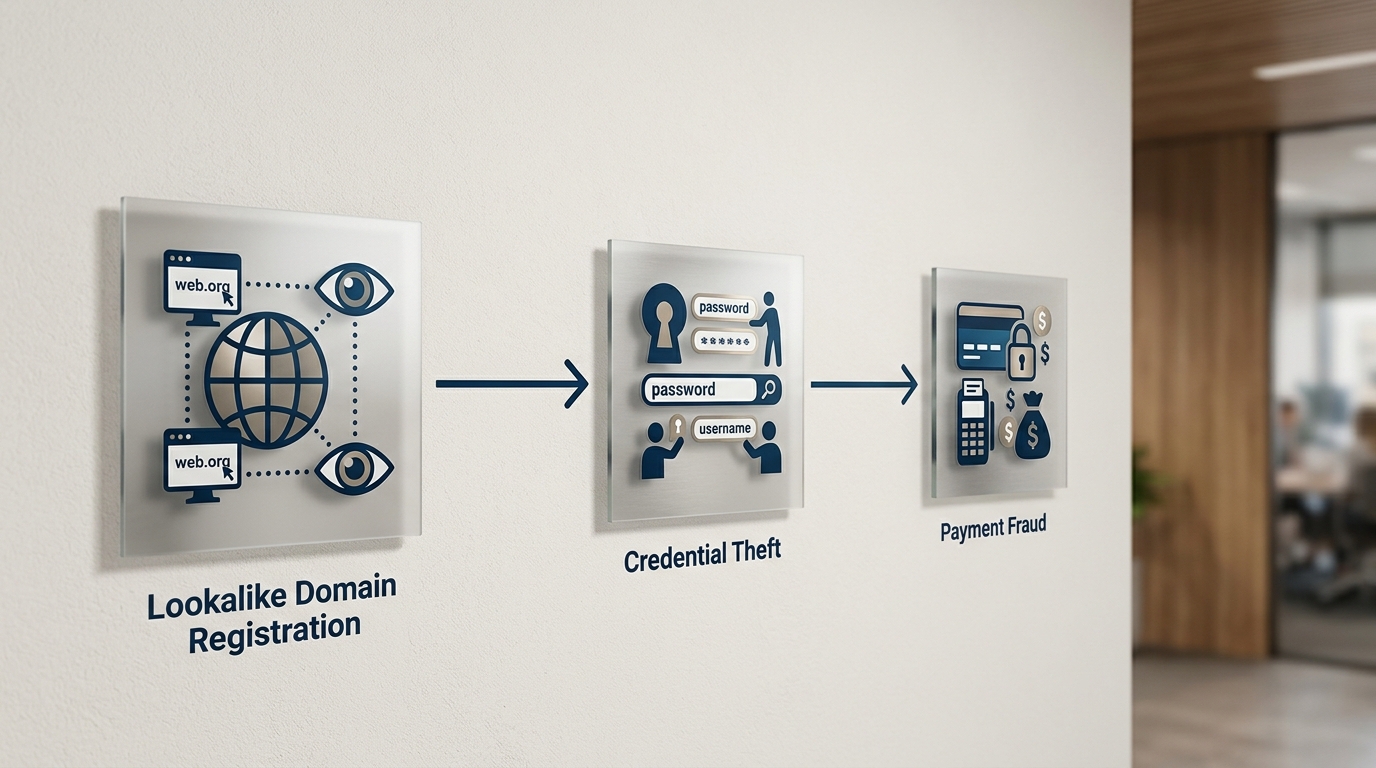
The Silo Problem: Why Isolated IT Security Leaves Gaps
In many medium-sized enterprises, IT operations, brand protection, and financial controls are managed in separate departments. While the IT team manages firewalls and endpoint security, marketing oversees domain assets and finance verifies incoming invoices. Cybercriminals exploit this artificial separation. Rather than attacking through a single vector, modern adversaries combine tactics across organizational boundaries. An integrated strategy like Digital Risk Protection (DRP) addresses this challenge by continuously monitoring external risk indicators across all channels.
Official reporting from the BSI on the state of IT security in Germany emphasizes the speed and scale of modern threat activity. During the latest reporting period, the agency recorded a 26 percent increase in new malware variants, averaging over 300,000 new variants every single day[1]. This volume demonstrates that point-solution defenses are insufficient against organized cybercrime networks.
- Silo risks: Isolated defenses detect suspicious activity only after internal systems have already been compromised.
- Cross-channel attack chains: Threat actors combine domain spoofing, targeted phishing, and fake invoices into unified campaigns.
- Perimeter blind spots: Conventional IT tools monitor corporate networks, but remain blind to lookalike domains and leaked credentials on external networks.
Treating security risks in isolated organizational silos leaves companies vulnerable to external warning signs. Connecting brand monitoring, identity protection, and payment security provides the comprehensive early-warning capability required to detect multi-stage threats before operational impact occurs.
Brand Abuse: Fake Shops and Typosquatting
Brand impersonation is a primary method used by threat actors to manipulate established trust. A prominent technique is typosquatting, where attackers register web domains that closely resemble a legitimate corporate address. Minor typographical variations allow fraudsters to redirect customers, partners, and employees to fraudulent online environments.
The global scale of brand abuse continues to expand. Findings from the Gen Threat Report show that Gen blocked 114.2 million attacks via fake online stores worldwide, up 109 percent[2]. Beyond direct financial losses, victimized companies suffer long-term erosion of customer trust and enterprise reputation.
Research conducted for the Verbraucherzentrale Brandenburg consumer advice center reveals that 4.4 million citizens in Germany have already fallen victim to counterfeit online stores[3]. Criminals leverage established mid-market brand identities to lend credibility to counterfeit operations and malicious campaigns.
| Attack Type | Attacker Strategy | Organizational Impact |
|---|---|---|
| Typosquatting | Registering lookalike domains with slight typos | Erosion of customer trust and interception of sensitive emails |
| Fake Shops | Deploying cloned website layouts and official logos | Reputational damage and influx of customer complaints |
| Domain Grasping | Acquiring expired or related top-level domains | Extortion risks and brand misuse in phishing campaigns |
Without continuous automated detection of newly registered domains, brand misuse can persist undetected for extended periods. By the time customers report deceptive sites, significant brand equity may already be compromised.
The Invisible Threat: Data Leaks and Stolen Credentials
Corporate brand identity and employee credentials represent high-priority targets for cybercriminals. Compromised user accounts and stolen passwords frequently originate from targeted phishing or third-party data breaches. Once obtained, these credentials are traded on underground marketplaces, providing illicit access for follow-on attacks.
The economic impact of unauthorized data exposure is substantial across the economy. According to the Bitkom economic protection study, data theft, industrial espionage, and sabotage cause an estimated 289.2 billion euros in annual damage to German businesses, with 70 percent of losses stemming directly from cyberattacks.
- Communication data exfiltration: Bitkom data indicates that 69 percent of affected businesses experience unauthorized access to emails and messaging records.
- Customer data exposure: 57 percent of impacted organizations report theft of sensitive customer information.
- Compromised internal logins: 27 percent of targeted firms experience unauthorized access to corporate authentication portals.
For executive leadership, a single stolen password combined with weak authentication mechanisms can bypass external security boundaries. Continuous dark web and breach monitoring is essential to detect compromised credentials before adversaries utilize them to access internal assets.
The Financial Endpoint: Fake President and Payment Fraud
Direct financial theft represents the primary objective of most multi-stage cyberattacks. Once threat actors acquire corporate credentials or establish spoofed domains, they execute targeted fraudulent transactions. Common techniques include invoice fraud and CEO fraud, frequently referred to as the Fake President scam.
In these scenarios, perpetrators impersonate senior executives to instruct finance personnel to process urgent wire transfers. Attackers also alter payment details on legitimate supplier invoices prior to transmission. Threat actors increasingly leverage messaging channels; security researchers at Kaspersky have documented a campaign using compromised WhatsApp accounts of legitimate contacts to distribute malicious script files disguised as invoices, account statements, and payment reminders[4].
- Reconnaissance: Attackers monitor email threads and review executive calendar patterns.
- Impersonation: Urgency is established through spoofed sender addresses or hijacked messaging accounts.
- Pressure tactics: Strict confidentiality is mandated to prevent internal verification.
- Fund diversion: Capital is transferred to offshore accounts or intermediary financial agents.
Financial staff face intense psychological pressure during targeted impersonation attempts. Technical safeguards and automated document verification are vital to support human awareness when personnel face compressed deadlines.
The Anatomy of a Combined Cyberattack
Modern cyberattacks rarely rely on a single isolated exploit. Instead, adversaries structure multi-stage campaigns where each phase builds upon the previous one. Understanding how distinct threat vectors interlock is critical for developing effective defense strategies.
- Domain acquisition and spoofing: Threat actors register lookalike domains and replicate corporate branding assets.
- Credential harvesting: Targeted phishing campaigns exploit lookalike domains to collect valid employee logins.
- Lateral escalation and channel manipulation: Compromised accounts on platforms like WhatsApp are used to distribute weaponized documents to trusted contacts[4].
- Fraudulent transaction execution: Manipulated invoice files or urgent transfer requests are submitted to accounting.
Because each stage occurs across different channels and operational silos, traditional perimeter security controls often fail to correlate the individual indicators. Detecting the initial setup phase outside the firewall prevents the attack from escalating to financial execution.
Digital Risk Protection in Practice: The Combined View
Digital Risk Protection provides unified external visibility by consolidating threat signals from brand monitoring, identity exposure tracking, and transaction verification into a coherent operations interface. Rather than evaluating isolated alerts, security teams obtain a holistic view of external risk exposure.
By extending defense perimeters beyond internal networks, DRP platforms monitor domain registration feeds, dark web marketplaces, and messaging channels. Against a background threat level of roughly 309,000 new malware variants per day recorded in the BSI reporting period[5], proactive intelligence enables early intervention during adversary reconnaissance.
Core Pillars of Digital Risk Protection
- Brand and domain monitoring: Automated scanning of domain registries to identify typosquatting and fake shops instantly.
- Credential breach tracking: Continuous monitoring of dark web databases to flag leaked employee logins before network intrusion occurs.
- Transaction and document security: Technical verification of incoming payment requests and invoice metadata to stop financial fraud.
Unifying these protective measures enables mid-sized enterprises to detect complex campaigns in their early phases, shifting security management from reactive incident response to proactive threat prevention.
Holistic Protection with Cybersecurity and Compliance
Effective digital risk management requires combining external risk monitoring with robust internal defense controls. Integrating continuous 24/7 SOC and SIEM monitoring, advanced Endpoint Detection and Response (EDR), and structured risk management ensures complete coverage across all attack vectors.
Given that 89 percent of businesses face persistent threats resulting in 289.2 billion euros in annual damages across Germany, regulatory frameworks such as NIS2, ISO 27001, and DSGVO demand verifiable risk management procedures.
Managing these requirements requires integrated solutions that align technical security with regulatory governance. Service offerings like CAVRIX Cybersecurity provide continuous 24/7 threat detection and response alongside NIS2 compliance alignment, while CAVRIX Compliance automates evidence collection and audit reporting. Through unified operational interfaces like Command Center and fully managed IT operations via Managed IT, mid-sized enterprises maintain robust cyber resilience and regulatory readiness across all business units.
Frequently Asked Questions
What is Digital Risk Protection (DRP)?
Digital Risk Protection (DRP) is a holistic security approach that monitors external threats across channels. It combines brand protection, fraud prevention, and credential leak detection to uncover combined attacks before they penetrate internal networks.
How does typosquatting harm a brand's reputation?
Typosquatting involves registering domains that look deceptively similar to your real one. Fraudsters use these to create fake online shops or intercept confidential emails, destroying customer trust. In fact, over 4.4 million Germans have already been victims of fake online shops.
Why is traditional IT security no longer sufficient for SMEs?
Traditional IT security focuses on the internal perimeter, like firewalls and antivirus software. However, modern attackers combine external vectors like fake domains, phishing, and fake invoices. With over 300,000 new malware variants emerging daily, perimeter defense alone leaves blind spots.
What is the true cost of data leaks for the economy?
The financial impact is staggering. According to a recent study, data theft, espionage, and sabotage result in a total annual damage of 289.2 billion euros to the German economy, with cyberattacks accounting for 70 percent of these losses.
How does the Fake President fraud operate?
Also known as CEO fraud, attackers impersonate management or executives to instruct urgent transfers of large sums. They often utilize compromised accounts or messenger apps to send fake invoices, applying immense psychological pressure on the accounting department.
Can cybersecurity and compliance work together against these threats?
Yes. Integrating continuous monitoring via a Security Operations Center with compliance frameworks like NIS2 ensures that vulnerabilities are not only detected but also systematically managed and documented, closing the gap between IT security and risk management.