Brand piracy in e-commerce: stopping counterfeits
How mid-sized companies stop brand piracy: finding counterfeits on marketplaces and having them removed on a sound legal basis. Protect your brand effectively.
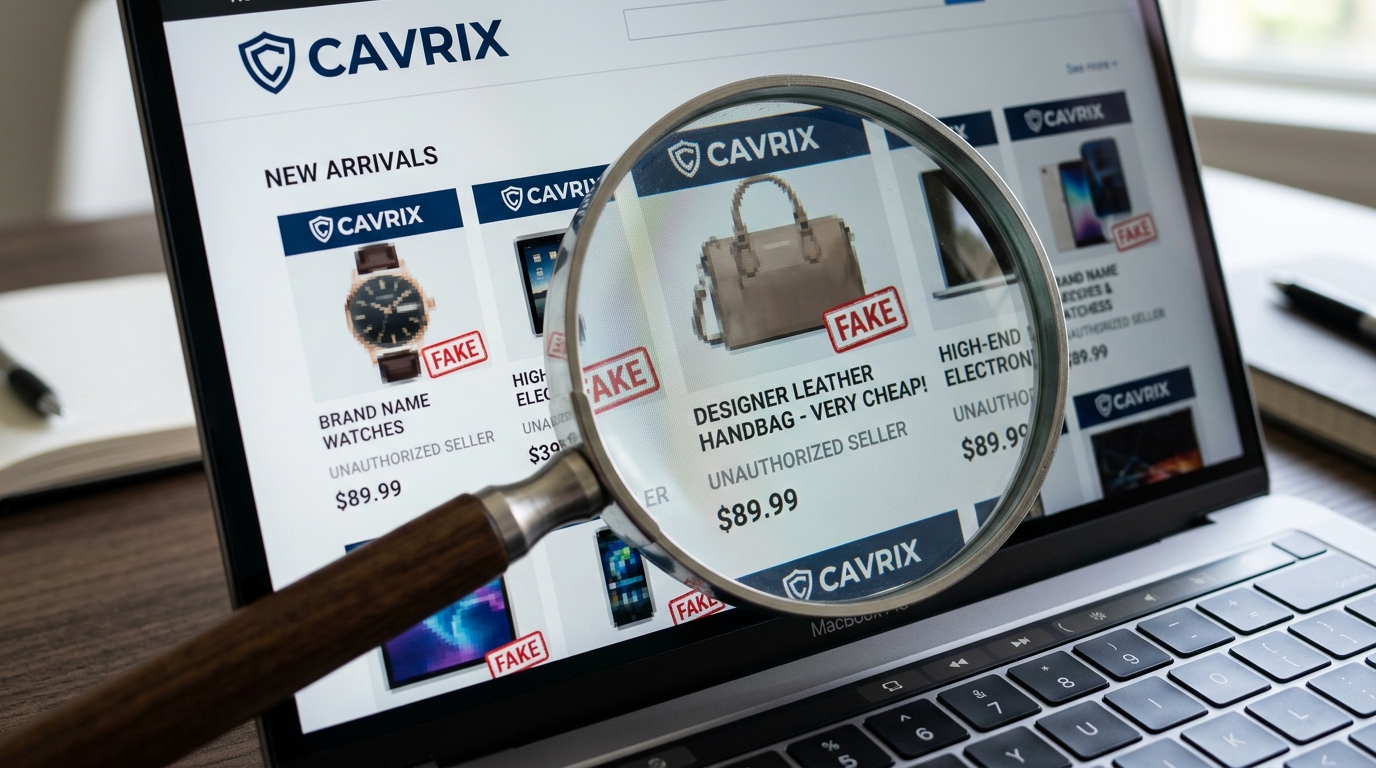
The scale of brand piracy in digital commerce
Counterfeit products have long since stopped being a problem that only affects global luxury brands. Research-intensive German Mittelstand companies are increasingly in the crosshairs of organised counterfeiters in e-commerce too. When fake spare parts, tools or consumer goods appear under your name on large online marketplaces, your business faces more than immediate lost revenue. Often the lasting loss of trust among your B2B or B2C customers weighs far more heavily, especially when inferior imitations fail or carry safety risks. For you as a managing director, protecting your registered trade marks and patents is therefore a question of survival. Anyone who does not monitor the digital market systematically leaves the field to criminals and puts their own market position at risk.
German customs statistics show just how large the volume is: in 2024, customs seized counterfeits worth around 417 million euros and took around 5 million counterfeit items out of circulation in 16,857 seizures[5]. The legal basis for this is Regulation (EU) No 608/2013 on customs enforcement of intellectual property rights, under which you can file an application for action as a rights holder. Because counterfeiters operate ever more professionally and use digital sales channels to put fake products into circulation, the economic damage is considerable. For you as an IT manager or decision maker this means that proactive protection of your trade mark rights should be a fixed part of your IT security strategy. Modern cybersecurity for mid-sized companies today no longer protects only your internal networks, it also secures your digital identity and brand presence on the web against fraudulent misuse.
The legal basis: securing trade mark and patent protection
If, as a managing director or IT manager in a mid-sized company, you want to take action against counterfeits on online marketplaces, a complete IP portfolio (intellectual property) forms the legal foundation. The better your industrial property rights are documented, the faster you will make progress in the digital space. Marketplace operators require comprehensible proof of your ownership of the rights as part of their standardised reporting procedures (take-downs). A registered trade mark is not, however, a mandatory prerequisite: the general reporting forms of the marketplaces also allow you to assert copyright, design and patent rights, for example in your original product photos. Admission to the Amazon Brand Registry, by contrast, requires a registered or at least applied-for trade mark. The German Patent and Trade Mark Office (DPMA) and the European Union Intellectual Property Office (EUIPO) maintain these central registers. The figures show how essential protecting your own identity is for German businesses: in 2024 alone, the DPMA recorded a total of 80,365 national and international trade mark applications[1].
- National and EU trade marks: they protect names, logos, slogans and the design of your products and are the most important defensive weapon against deceptively realistic counterfeits.
- Patents and utility models: these secure technical inventions and functional processes, which prevents imitators from copying the functionality of your product.
- Registered designs: they protect the external appearance (shape, pattern, aesthetics) of your physical product and prevent visual imitations in the market.
Systematically building up your portfolio of industrial property rights is therefore the first step towards having digital counterfeits removed quickly and on a sound legal basis. If your trade marks, patents and designs are registered without gaps, you can have illegal listings removed considerably faster. As a holistic IT partner, CAVRIX supports mid-sized companies not only with classic cybersecurity, it also protects your digital identity as part of our fraud prevention and verification services. If you have questions about protecting your systems or your IP infrastructure, you can get in touch with us directly at any time for a free consultation.
Systematic searching: how to find counterfeits online
Identifying counterfeits on digital marketplaces is a growing challenge for German mid-sized companies. Fake products not only damage your revenue, they also ruin the customer trust you have built up over years. According to a study published in January 2024 by the European Union Intellectual Property Office (EUIPO), counterfeit products cause annual revenue losses of around 16 billion euros in the EU in the three sectors of clothing including footwear, cosmetics and toys alone, and cost almost 200,000 jobs there. To protect your products effectively on platforms such as Amazon, eBay or Asian trading portals, you have to proceed systematically.
Warning signs on online marketplaces
For IT managers and managing directors, the search usually starts with manual research. In doing so, you should watch out specifically for certain warning signs that point to fraudulent listings. These include extremely low prices far below your calculated market price, as well as incomplete legal notice details from third-party sellers. Foreign free riders often also use a manipulated presentation of your brand or fall back on slightly altered brand names. Because purely manual monitoring of foreign platforms is extremely time-consuming, the use of automated screening tools is becoming increasingly important.
- Extreme price deviations: listings priced well below the usual production or distribution costs.
- Dubious seller profiles: missing contact details, incomplete registrations or frequently changing seller names.
- Copyright infringements: unauthorised use of your protected original product photos, logos or marketing texts.
- Suspicious delivery routes: shipping from third countries known for a high density of counterfeit manufacturers.
To protect your brand in the long term, an occasional search is not enough. Effective protection requires seamless integration into your entire IT infrastructure. Beyond simply protecting your IT systems, CAVRIX supports you as part of modern cybersecurity in monitoring digital threats and defending your IP rights effectively. For advice on our protection solutions you can reach us at any time at info@cavrix.de. This combined approach secures the future of your company sustainably.
Notice-and-Take-Down: removing counterfeits from marketplaces
If you discover a trade mark infringement on an online marketplace, you do not have to stand by idly. The European Digital Services Act (DSA) obliges platform operators in Article 16 to provide structured notice and action mechanisms[2]. Separately from this, Article 22 DSA governs the status of trusted flaggers, whose reports must be processed with priority and without delay. As soon as a marketplace receives a sufficiently precise and substantiated report about an infringement of industrial property rights, it is deemed to have knowledge. If it then fails to act promptly against the listing, it loses its liability exemption for the illegal content.
A legally effective infringement report has to be structured precisely in order to bring about immediate blocking of the listing concerned:
- A precise explanation of why the listing infringes your trade mark rights.
- The exact URL of the illegal listing for unambiguous identification.
- The identity of the rights holder including your contact details for follow-up questions.
- A statement in good faith that your information is accurate and complete and that you are the rights holder or acting on their behalf.
To speed up processing, you should use the platform-specific reporting portals. Leading marketplaces have established their own protection programmes, such as the Amazon Brand Registry or eBay's VeRO programme (Verified Rights Owner)[3]. Reports submitted through these portals follow standardised paths and are usually processed faster than informal notices. Should an operator fail to react or react only with a delay, legal escalation through a cease-and-desist letter or a preliminary injunction is the next logical step.
For managing directors and IT managers in mid-sized companies, continuous automated monitoring is the most important lever for detecting counterfeits in the first place. CAVRIX supports you not only within your IT infrastructure, it also extends protection through targeted fraud prevention and digital verification as part of modern cybersecurity for your company. That way you protect your company's reputation and prevent lost revenue proactively. If you have questions, you can reach the team at any time at info@cavrix.de.
Acting on a sound legal basis: test purchases and legal steps
If simple marketplace reports fail or counterfeiters keep reappearing under changing profiles, you have to pull harder legal levers. The joint report Mapping Global Trade in Fakes 2025 by the OECD and the EUIPO puts global trade in counterfeits for the reference year 2021 at around 467 billion US dollars, which corresponds to 2.3 percent of world trade[4]. For German mid-sized companies that is a serious threat. In order to enforce claims for damages successfully or to block distribution permanently, complete evidence that can be used in court is absolutely essential, and it has to be secured before the counterfeit listings are deleted from the platforms and important traces disappear with them.
Legal enforcement in e-commerce
A professionally documented test purchase forms the legal foundation of your approach. Here you order the suspected counterfeit and document the entire process forensically. This includes the complete preservation of all listing details in the browser in accordance with Section 371 of the German Code of Civil Procedure (ZPO) as well as the physical retention of the delivery including packaging and shipping documents. This carefully documented chain of evidence is absolutely essential in order to prove the infringement of your trade mark rights under Section 14 of the German Trade Mark Act (MarkenG) beyond doubt in court.
- Forensic preservation of evidence: secure screenshots, metadata and the URL of the counterfeit listing before you initiate legal steps or inform the marketplace.
- Documented test purchase: record the order, the payment flows and the unboxing of the delivered goods in order to prove the counterfeit physically and beyond doubt.
- The cease-and-desist letter: through a specialised law firm, call on the infringing seller to submit a declaration to cease and desist with a penalty clause and to provide information.
- Preliminary injunction: if there is no reaction, promptly file an application for interim relief with the court in order to stop the sales immediately. The courts apply an urgency deadline for this, which is measured differently depending on the higher regional court.
With this structured approach you secure your market share and the trust in your brand. Because modern brand piracy in e-commerce is often closely linked to cybercrime, CAVRIX supports you as an AI-native partner for mid-sized companies. Alongside cybersecurity, our portfolio also covers tailored fraud prevention and digital verification in order to safeguard your business assets. Use professional and effective IP protection as a strategic shield for your corporate security.
Integrated protection: how cybersecurity helps your brand
Brand piracy today is long since no longer limited to counterfeit products on sales platforms. Cybercriminals increasingly target your company's digital reputation by creating deceptively realistic copies of your website or launching phishing campaigns in your brand's name. Current figures show that this danger is real: according to Kaspersky's spam and phishing report for 2024, this provider's solutions alone blocked around 37.5 million phishing attempts in Germany, an increase of around 16 percent compared with the previous year. Such fake emails and websites not only cause direct financial damage to your partners, they also permanently destroy trust in your brand. Marketplace protection alone falls short of countering these professional attacks effectively. Only integrated cybersecurity protects your brand and your customers comprehensively against fraudulent activities.
Fending off fake domains and protecting the IT infrastructure
Fraudsters often register deceptively similar web addresses, known as lookalike domains, in order to deceive your partners or customers. Through these channels they distribute malware or intercept sensitive access credentials. Effective protection therefore requires monitoring of the domain name space and systematic hardening of the entire IT environment. With cybersecurity from CAVRIX you protect your company at every level, perfectly complemented by a stable Managed IT setup. This includes automated detection of domain abuse and phishing attempts as well as protection of your own email infrastructure against unauthorised misuse through the implementation of modern protocols such as DMARC, DKIM and SPF.
- Continuous domain monitoring to detect lookalike domains
- Defence against brand phishing through automated security analyses
- Increased protection of your email communication against spoofing
- Holistic hardening of your IT infrastructure to safeguard your digital assets
Through this combination of preventive monitoring and strong IT security, you deprive fraudsters of the basis for misusing your brand for attacks on your customers or partners. If you have questions about holistic protection of your brand and the implementation of modern security standards, the CAVRIX team is available for personal advice at info@cavrix.de.
Digital verification: future-proof defence with CAVRIX
Protecting your own products and fending off digital fraud attempts are a strategic priority for managing directors and IT managers in mid-sized companies. The threat posed by brand piracy in e-commerce is growing steadily. To safeguard your SME comprehensively against financial losses and reputational damage, CAVRIX is specifically expanding its portfolio to include modern fraud prevention, brand and IP protection, and digital verification solutions.
- Authenticity checks for documents: intelligent algorithms analyse invoices, documents, emails, images, damage reports and background checks in real time for manipulation, so that forged evidence is exposed immediately.
- Managed IP protection: systematic, continuous monitoring of relevant online marketplaces identifies counterfeits of your products early and immediately initiates the legally sound take-down process.
- Digital identity verification: complete verification of digital identities protects your supply chains against fraudulent actors and ensures that only authorised partners and customers interact with your systems.
These new protective mechanisms are fully integrated into the CAVRIX platform architecture. They complement our proven cybersecurity, which protects your company around the clock against cyber threats, as well as our automated modules for NIS2 compliance. That way you secure not only your IT infrastructure but also the integrity of your brand and your business documents through a central dashboard. If you have questions about our new services or would like personal advice, you can reach our expert team directly by email at any time at info@cavrix.de or via our contact form.
Frequently asked questions
How do I find counterfeit versions of my company's products on the internet?
You can carry out manual searches for your brand terms on large marketplaces or use automated monitoring tools that scan for unusually low prices and suspicious product images.
What is the Notice-and-Take-Down procedure?
It is a legal process in which you inform the marketplace operator about a specific copyright or trade mark infringement. After this report, the operator must examine the notice promptly and diligently and remove illegal listings.
What evidence do I need for a successful removal?
Your register data at the patent office (DPMA/EUIPO) or other proof of your rights, for example in the original product photos, is helpful, as is the exact URL of the counterfeit. In complex cases a documented test purchase is advisable in order to prove the counterfeit physically.
Can I claim damages from counterfeiters?
Yes, in the case of a proven trade mark infringement you are entitled to claims for injunctive relief, information and damages. This usually requires a formal cease-and-desist letter from a specialised lawyer.
How does CAVRIX help protect against brand piracy?
CAVRIX extends your protection through integrated cybersecurity and fraud prevention. We help your mid-sized business fend off fraudulent domains, phishing pages and the theft of your identity.