AI Video Surveillance for SMEs: Securing IP Cameras as an Attack Vector and Monitoring Them with AI
Learn how to protect your SME's IP cameras from hackers and improve video surveillance with smart AI analysis and real-time alerts, GDPR-compliant.
The unnoticed risk on your network: why IP cameras are an entry point for hackers
When you think about securing your business, the first things that probably come to mind are firewalls, email filters, or protecting your endpoints. IP security cameras are often overlooked in the process. They hang inconspicuously from ceilings, watch over warehouses or outdoor areas, and seem to do their harmless job. Yet while they are physically your eyes, digitally they are often wide-open barn doors. Because they are connected directly to the company network, they give attackers an ideal bridge to slip deep into your IT infrastructure unnoticed and, in the worst case, deploy ransomware.
Many of these devices are simply forgotten after installation. They run for years with the default passwords set at the factory and without any security updates. Hackers use automated scanners to search the internet specifically for such vulnerabilities. Once infected, the cameras become part of global botnets like Mirai, which are abused for coordinated large-scale attacks. As a managing director or IT lead in the Mittelstand, you have to actively minimize this risk before any damage is done.
Outdated firmware as a global security risk
Concrete figures show that this is not a theoretical scenario. A large-scale study by security vendor Genetec found that around 68 percent of all analyzed surveillance cameras worldwide run outdated firmware[1]. That means more than two thirds of all active cameras have known security vulnerabilities that criminals can easily exploit. Often a company simply lacks the time or the tools to keep dozens of cameras regularly updated.
- Unchanged default passwords that appear in publicly accessible lists on the internet.
- Missing encryption when transmitting video and control data.
- Direct integration into the main network without logical separation from sensitive systems.
- Outdated software versions for which well-known, documented exploits already exist.
Closing these vulnerabilities requires consistent safeguards. That includes clean network segmentation to isolate cameras from the rest of the company network, as well as continuous patch management. With our Managed IT service, we not only handle the ongoing maintenance of your IT systems but also keep an eye on security risks like these.
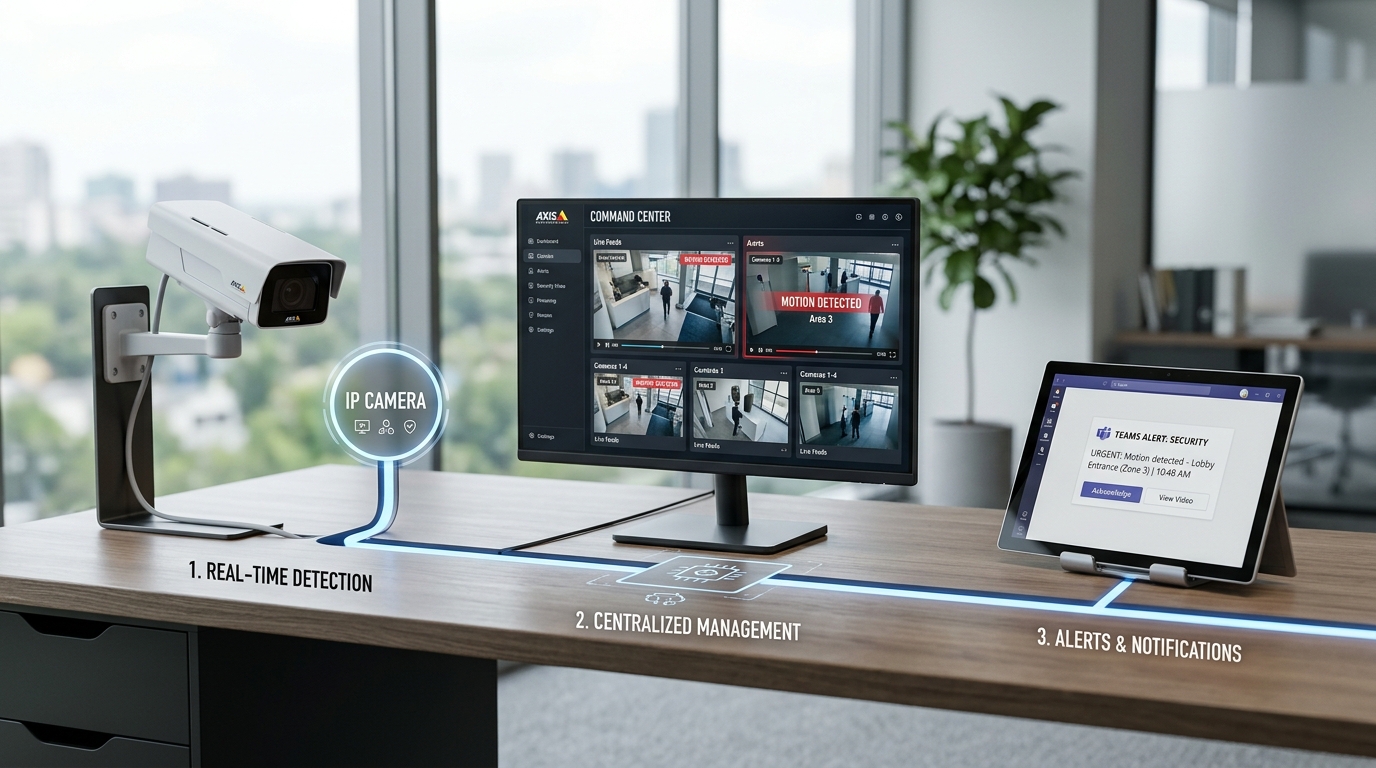
The solution lies in a two-stage approach. First, you have to secure the cameras at the network level through strict segmentation, so that a compromised device does not put the entire company at risk. Second, you can pair the secured camera feeds with modern AI video analysis. This evaluates the footage in real time for anomalies after hours or unauthorized movement. If an incident occurs, the alert lands directly in your Command Center, so you can react immediately, before any physical or digital damage is done.
The threat from IoT botnets: how cameras become a weapon against your business
IP security cameras are indispensable in many mid-sized businesses for physically protecting buildings and grounds. Digitally, however, these IoT devices often turn into dangerous barn doors for cybercriminals. As soon as hackers hijack an unsecured camera on your network, they can easily use it as a springboard. From there they move laterally through the company network to siphon off sensitive business data or install devastating malware.
From physical protection to a digital threat
Just how far-reaching this threat really is in the IoT space is shown by the Badbox IoT botnet documented by the BSI in its situation report, which exposed considerable risks with more than 58,000 infected devices[2]. Compromised cameras become part of global botnets without you noticing any change during day-to-day operation. The criminals abuse the computing power and bandwidth of your hardware for massive attacks on third parties, or use the access as an entry point for a devastating ransomware attack on your internal servers.
- Infiltration: attackers scan the internet automatically for publicly reachable cameras with outdated firmware or factory settings.
- Takeover: the attackers infect the system with malware and quietly enroll it into a global botnet.
- Lateral movement: through the compromised camera, the hackers push deeper into your local network to scout out servers and workstations.
- Attack launch: encryption of data, theft of confidential information, and extortion of a ransom.
To permanently minimize this security risk in the Mittelstand, simple antivirus software on the office PCs is no longer nearly enough. It requires professional network segmentation and continuous monitoring of all interfaces. With CAVRIX's Cybersecurity service, your infrastructure is analyzed around the clock. Unusual data flows originating from IoT devices are detected and blocked immediately. All incidents come together directly in the Command Center, so that anomalies are stopped right away.
An experienced partner helps you systematically close such vulnerabilities and patch outdated firmware versions. By strictly separating camera and production networks, you effectively prevent a single compromised IP camera from becoming an existential threat to your entire company.
The foundational safeguards: three steps for your camera security
Many companies in the German Mittelstand see IP cameras primarily as a physical protection measure for their premises. Digitally, though, unsecured cameras are often open barn doors for professional attackers. Malware like the infamous Mirai botnet impressively demonstrated how easily networked cameras can be taken over when they hang unprotected on the network. With a simple list of just 62 default usernames and passwords, Mirai infected hundreds of thousands of devices worldwide at the time[3]. As a managing director or IT lead, you therefore have to act immediately to secure your surveillance infrastructure and prevent break-ins into the rest of your company network.
Network segmentation using a VLAN
The first and most important step is strictly separating your video cameras from the rest of the company network. If the cameras sit on the same network as your accounting, customer data, or ERP systems, an attacker can freely access every other system after hacking a single camera. By setting up a virtual local area network (VLAN), you completely isolate the cameras' traffic. Even if a camera is compromised, the damage stays limited to this isolated segment. This measure is part of the standard for modern defense in cybersecurity and prevents attackers from moving laterally in an emergency.
Changing all default credentials
It sounds trivial, but in practice it is often forgotten during the quick installation of surveillance cameras: changing the manufacturer's default credentials. Many cameras ship with factory combinations like admin/admin or admin/12345. Hackers scan the internet automatically for such known logins. So before putting a camera into operation, change every password to a complex, unique string. In addition, you should disable unencrypted connection protocols like HTTP and rely exclusively on encrypted HTTPS connections to prevent passwords from being intercepted on the local network.
Establishing proactive patch management
Like any other software, the operating systems of IP cameras regularly contain security vulnerabilities. Manufacturers release firmware updates to close these gaps. Without a structured process, however, cameras remain unpatched for years and thus permanently vulnerable. Proactive patch management ensures that security updates are applied promptly and automatically. If you cannot muster these resources internally, an external partner can help you keep all endpoints and IoT components fully up to date as part of Managed IT.
- VLAN segmentation: separating the camera network from the operational business network to prevent lateral attacks.
- Password hygiene: immediately replacing all default passwords with complex passwords and disabling unnecessary protocols.
- Automatic patching: regularly applying the latest firmware updates from manufacturers to close known security gaps.
- Real-time monitoring: continuously watching the cameras' network activity for anomalies and unusual data outflows.
Securing the hardware forms the solid foundation. Only on this basis can modern AI video analysis reach its full potential and report incidents to your Command Center in real time. That is how you turn unprotected IoT devices into an active, closed shield for your entire company.
From a passive picture to active defense: AI video analysis in real time
Classic surveillance cameras in the Mittelstand have a fundamental problem: they usually only record footage passively. If someone breaks into your factory hall or warehouse at night, the conventional camera often only delivers blurry images after the fact of thieves who are long gone. Modern IP cameras with built-in AI video analysis change this principle fundamentally. Instead of just silently watching and filling hard drives, they evaluate the video streams actively and in real time. This turns physical cameras from mere documentation tools into a proactive protection system that detects threats while they are still unfolding.
Minimizing false alarms and verifying incidents
A major obstacle with the classic motion detection of older systems is the flood of false alarms. Whether it is passing clouds, leaves blowing in the wind, or a stray animal in the parking lot: every small change in the image triggers a warning. For IT leads and managing directors in the Mittelstand, this quickly leads to so-called alert fatigue. AI-powered systems, on the other hand, use deep learning algorithms to precisely distinguish human silhouettes and vehicle types from environmental noise. Studies show that such targeted analysis can reduce false alarms by up to 99.9 percent. When a genuine anomaly occurs, it is reported directly to the Command Center. By connecting to professional security monitoring, the incident can be verified within seconds and an immediate intervention triggered.
- Precise object detection: reliably distinguishing between real threats such as people or vehicles and harmless movements of animals or plants.
- Real-time alerting after hours: automated notifications straight to the Command Center as soon as unauthorized people enter your premises after closing time.
- GDPR-compliant image analysis: local filtering and privacy-compliant storage that fully meets the strict requirements of European law.
- Holistic IT security: seamlessly linking physical surveillance with your digital network security to prevent attacks on the cameras themselves.
Implementing and safely operating such an intelligent solution does not have to be an additional burden for your internal team. A managed security partner supports you in securing the cameras at the network level and processing the data flows in a GDPR-compliant way. Combined with CAVRIX's comprehensive Cybersecurity services, your mid-sized business stays fully protected both digitally and physically. The analysis runs in the background while you conveniently keep an eye on all relevant events and your company's security status through your Command Center.
Integration into the Command Center: seamless reporting to your digital control room
Intelligent video surveillance does little good if the alerts it generates gather dust in a cluttered web interface. For AI-based detection of security incidents to deliver real value, critical events have to be reported immediately where you and your team already work. This is exactly where integrating your camera systems into the Command Center comes in. Instead of monitoring separate portals, you bundle all incidents in one central digital control room.
The need for an immediate response is underscored by the speed of modern cyber threats. According to security researchers, insecurely configured IP cameras on the network can be infected by malware like the Mirai botnet within just 98 seconds of being connected[4]. When a physical or digital break-in attempt happens, every second counts. The Command Center processes the real-time data from your AI cameras directly and forwards the alerts without delay.
Through CAVRIX's intelligent platform, these alerts are sent straight into your everyday communication channels such as Microsoft Teams, Slack, or WhatsApp. You receive a precise notification about the type of incident, for example detected movement on the premises after closing time, and can react right away. This significantly simplifies IT management for the Mittelstand, since no complicated specialized software has to be installed on your employees' devices.
- Real-time notifications directly in familiar chat tools without additional apps
- Automated pre-sorting by AI to avoid false alarms
- A direct link to CAVRIX's security experts for fast help
- Full logging of all events for later audits and compliance reports
On top of that, CAVRIX makes sure these critical interfaces are secured as part of your entire infrastructure. With our Cybersecurity service, we monitor your network around the clock. That way we ensure your cameras serve as a physical eye but never become an entry point for hackers. Rely on holistic security and protect your company effectively against digital and physical threats.
Legally sound and GDPR-compliant: what you need to consider for video surveillance
When you equip your premises with modern IP cameras, you create valuable physical security. At the same time, though, you enter data protection territory that is strictly regulated in Germany. Cameras that capture outdoor areas or workplaces deeply affect the privacy rights of employees, customers, and passers-by. So for you as a managing director or IT lead, the rule is: effective property protection only works if it is designed from the outset to be legally sound and in line with the General Data Protection Regulation (GDPR).
Warning signs and the 72-hour rule
The legal requirements for video surveillance in the Mittelstand leave little room for maneuver. One central point is transparency: all monitored areas must be marked with clear warning signs that are visible before entering the recorded zone. In addition, a strict deletion deadline applies to recorded footage. According to the recommendations of the German data protection authorities and established case law, recordings must generally be deleted automatically after 72 hours at the latest[5]. Longer storage is only permitted in justified exceptional cases, for example over weekends or holidays when no business is taking place and incidents cannot be noticed right away.
- Clear signage: highly visible signs with a pictogram and mandatory details about the responsible entity and the data protection officer.
- Strict purpose limitation: the surveillance must serve a specific, legitimate purpose, such as protection against burglary or vandalism.
- Proportionality: cameras may only be used where milder means such as fences or alarm systems are not sufficient.
- Automatic deletion: implementing a reliable mechanism that irreversibly overwrites recordings after a maximum of 72 hours.
- No surveillance of off-limits areas: break rooms, restrooms, or changing rooms are absolutely off-limits for cameras.
How cybersecurity and GDPR compliance merge
Security in the modern Mittelstand requires an integrated concept. Unsecured IP cameras are often digital barn doors for attackers. Through network-level segmentation, you prevent hackers from abusing your cameras as an entry point. Robust IT security protects your entire network from such threats. When you link your camera systems to the CAVRIX Command Center, an integrated artificial intelligence evaluates the video feeds after hours in real time without any personal data having to be stored permanently. That way you meet the requirements of the GDPR and at the same time benefit from seamless protection. Through the CAVRIX Trust Center, you can also review at any time how we protect your data and systems according to the strictest guidelines.
Managed security as a complete solution: how CAVRIX combines protection and compliance
As a busy managing director or IT lead in the Mittelstand, you often face the challenge of keeping both physical security cameras and digital network security in view at the same time. IP-based surveillance cameras provide excellent on-site protection, but on the internal network they are often neglected entry points for hackers. Without continuous care, default passwords and outdated firmware can lead to your devices being hijacked by botnets in a very short time. As a well-known experiment showed, a completely unprotected IP camera on the network can be infected by malware after just 98 seconds[4]. To eliminate this risk, you need an integrated security concept that seamlessly connects the operation of your IT with the protection of your IoT infrastructure.
A secure foundation with Managed IT and Cybersecurity
This interface is exactly where CAVRIX's holistic solutions come in. With the Managed IT service, mid-sized companies outsource the demanding administration of their networks. We handle the network-level segmentation of your video systems, so that cameras run in an isolated VLAN and get no access to business-critical data. At the same time, the Cybersecurity module provides continuous vulnerability management and regular firmware updates. Should unauthorized access or anomalies on the network still occur, our 24/7 monitoring raises the alarm immediately to stop the attack before it does damage.
Real-time defense and GDPR compliance in view
Securing the network is only the first step, however. The real strength of modern video systems unfolds when you pair the camera images with intelligent software. AI-powered video analysis evaluates your feeds in real time and detects objects, unexpected movements, or anomalies after hours. These events are transmitted directly to the Command Center, where you and your team can receive and manage all alerts in your everyday communication channels. Since strict legal requirements always apply when using cameras, our integrated Compliance module helps you document all GDPR requirements completely and protect the privacy of your employees and customers in a legally sound way.
| Security area | Classic IoT operation | CAVRIX Managed Security |
|---|---|---|
| Network structure | Cameras sit on the regular company network and endanger internal IT systems. | Full isolation in dedicated VLANs to prevent attackers from moving laterally. |
| Maintenance and patching | Updates are applied irregularly or not at all, which opens security gaps. | Automated patch management and continuous review by our experts. |
| Incident response | Alarms have to be reviewed manually and are often only noticed the next day. | Immediate reporting of AI-detected anomalies straight to the Command Center. |
| Legal certainty | Increased data protection risks from unstructured storage and missing records. | Fully GDPR-compliant documentation via integrated Compliance requirements. |
The intelligent protection and monitoring of video systems requires no deep in-house expertise and no countless hours of overtime from your IT department. Through the interplay of structured network separation, automated maintenance, and AI-based live monitoring, you close critical security gaps for good. With an experienced partner at your side, you turn potential weak points into a reliable, legally compliant security architecture that protects your company around the clock.
Frequently asked questions
Why do IP cameras pose a security risk in the Mittelstand?
Many IP cameras are installed once and then neglected. Without regular updates, they run outdated firmware; according to one study, this affects around 68 percent of all cameras. On top of that, attackers frequently exploit passwords that are preset at the factory. Hackers can use these vulnerabilities to abuse the camera as a springboard into the internal company network, where they place ransomware or steal sensitive business data.
How do I protect my surveillance cameras from cyberattacks?
The most important step is network segmentation: strictly separate your cameras from the rest of your company network using a dedicated VLAN. Immediately change all default passwords to complex ones and disable unused network ports and services like UPnP. Structured patch management is also crucial to proactively close security gaps in the cameras' firmware. A managed security partner can handle these tasks for you automatically.
What does using AI bring to video surveillance?
Conventional video systems only record passively and often generate false alarms on movement (for example from wind or animals). AI video analysis, on the other hand, evaluates feeds in real time and can precisely distinguish between people, vehicles, and irrelevant movements. It detects anomalies after hours immediately and reports suspicious incidents without delay straight to your Command Center, so that your team or an external provider can respond right away.
Which legal GDPR rules apply to video surveillance on business premises?
For video surveillance in the Mittelstand, you have to comply with strict GDPR requirements. You must put up highly visible warning signs with clear information about data protection. The cameras may not permanently monitor employees' workplaces, unless very narrow exceptions apply. Recorded footage must generally be deleted automatically after a maximum of 72 hours. In addition, a data protection impact assessment (DPIA) must be carried out beforehand.
How does CAVRIX support my company with camera security and video analysis?
CAVRIX offers you a holistic, single-source solution. With our Managed IT service and the Cybersecurity area, we make sure your network infrastructure is segmented and your IP cameras are proactively supplied with the latest security updates. At the same time, our AI video analysis connects the camera feeds to the Command Center. That way you keep full control over your physical security and stay GDPR-compliant thanks to our Compliance module.